Course overview — introduction
Soils form over thousands of years
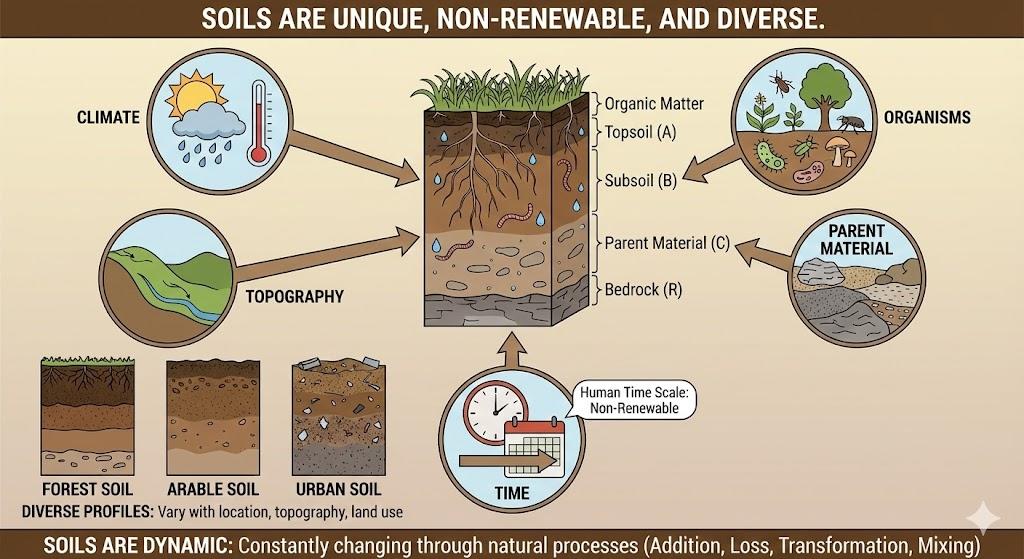
Soils are unique, incredibly diverse, and non-renewable within a human time scale. If you dig into the ground in different parts of the world, you'll see profiles with layers of different colors and characteristics. Also on a smaller scale, soils vary a lot when considering topography or land use — check out how an urban soil looks different from a forest, arable or wetland soil.
The Russian geologist Vasily Dokuchaev (1846-1903) is considered the father of soil science. His big insight is that soil is continually evolving, and is specific to each site. Soil formation is influenced by five main factors: climate, topography (land shape), organisms (plants, animals, and microbes), the type of parent material (rock or sediment), and time. These factors work together to create soils that are complex, living ecosystems, made up of minerals, organic matter, water, air, and a wide range of life — including bacteria, fungi, insects, and plant roots.
Soils are not static. They are constantly changing through natural processes like the addition of new material (like fallen leaves), the loss of nutrients (e.g. taken up by plants or lost through leaching into deeper parts of the soil or into groundwater), chemical transformations, and physical mixing. Because of these processes, soils vary greatly from place to place and even change over time.