Course overview — introduction
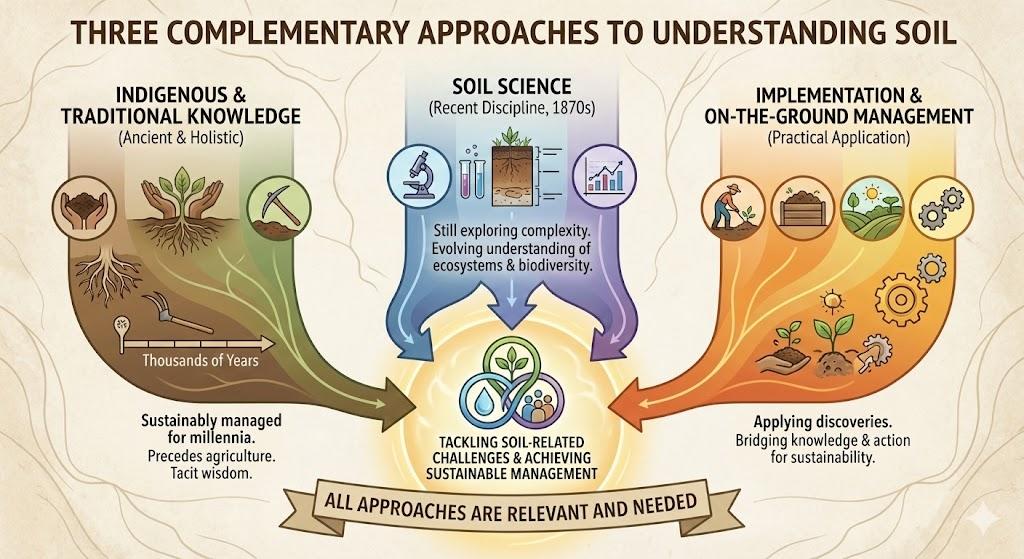
Three Complementary Approaches to Understanding Soil
Soils can be approached and understood in different ways. and all of them are relevant and needed to tackle soil-related challenges. Soils have often been sustainably managed by indigenous peoples and communities using traditional/tacit knowledge for thousands of years and still are in many parts of the world. This knowledge of soils precedes and goes beyond agriculture. Soil science is a recent discipline (1870s) and the complexity of soils is still not fully scientifically understood. Recent discoveries on soil ecosystems and soil biodiversity still needs to be explored further and more so implemented on the ground to achieve sustainable management of soils.
This diversity of knowledge isn’t just academic, it’s practical. For teachers, these three pathways (scientific, agricultural, Indigenous) offer lenses to make soil literacy resonate across cultures and subjects. For school leaders, they provide frameworks to design inclusive, community-anchored programs that honor local wisdom while meeting curricular goals.
Beyond the field of soil scientists, different groups have different understandings of what soils are. The ways in which soils are known, represented, and understood are diverse. In different regions, farmers, foresters, government officials, soil researchers, or environmental NGOs know soil in different ways and attach different meanings to it [5].
There is also the historic context of how soil science has emerged and developed as a topic seeking relevance within the scientific community and governance spheres over the past one hundred years, which adds another level of complexity to the discussion. Accounts of the history of soil science usually locate the origins of the discipline in the late 1800 with Vasiliy Dokuchaev [6], then the first international soil science congresses and conferences in 1909, 1924, and 1927 [7]. Based on Dokuchaev’s work, Hans Jenny developed, in the 1940s, a conceptual model of soil formation factors. In the early 1900s, soil-related concepts started developing and being published, such as soil fertility, soil productivity, and soil conservation. Before the 1970s, soil knowledge was mainly related to agricultural practices, and as technologies started developing (e.g., mechanisation, chemicals, and modified plant crops, namely the “first green revolution” [8]), there was a shift in this concept.