Course overview — introduction
The cycle of degradation
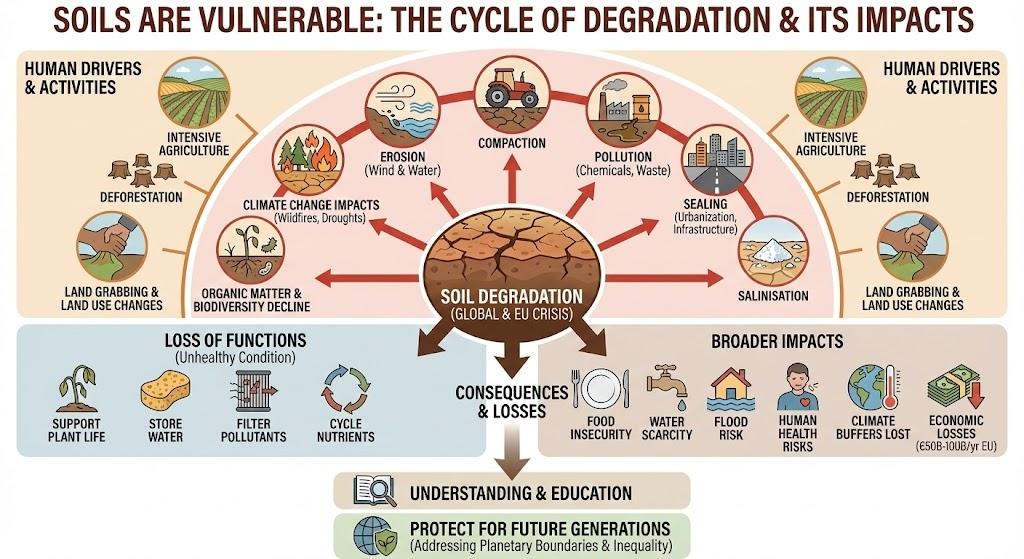
Soils around the world are under threat, and many are being damaged — a process known as soil degradation. This happens in different ways, but it's often caused directly by human activity. Examples of processes that threaten soils (or soil health) are: soil organic matter and biodiversity decline, erosion, compaction, salinisation, pollution and sealing — through various human activities like intensive agriculture, deforestation, other land use changes (including land grabbing or soil sealing), climate change (e.g. through wildfires, droughts, and windstorms) and others including desertification.
Currently, more than half of the world's soils are considered degraded and more than 60% of soils in Europe are in an unhealthy condition. This means they're losing their ability to function properly — to support plant life, store water, filter pollutants, and cycle nutrients. They are essential for food security, water availability and quality, contributing to flood control, functioning of ecosystems, human health, buffering of climate-change impacts and much more, also causing direct and indirect economic costs or losses, which are estimated between 50 billion to 100 billion Euros a year in the EU alone.
Furthermore, agriculture and with-it intensive soil use and often degradation is the major factor in exceeding the planetary boundaries, where seven of nine boundaries have been breached.
Soils and their human use, misuse and abuse also reflect not only our extractive and utilitarian often profit-driven relation to this essential resource (like with all other "natural resources"), but also show up in social relations, inequality and inequity, through who has or has not access and use rights and availability to soil and related resources and uses (e.g. land rights, land grabbing, etc.).
Understanding how land use affects soil is essential. By learning and teaching about soil, we can help protect this vital resource and make sure it continues to support life — now and for future generations.